
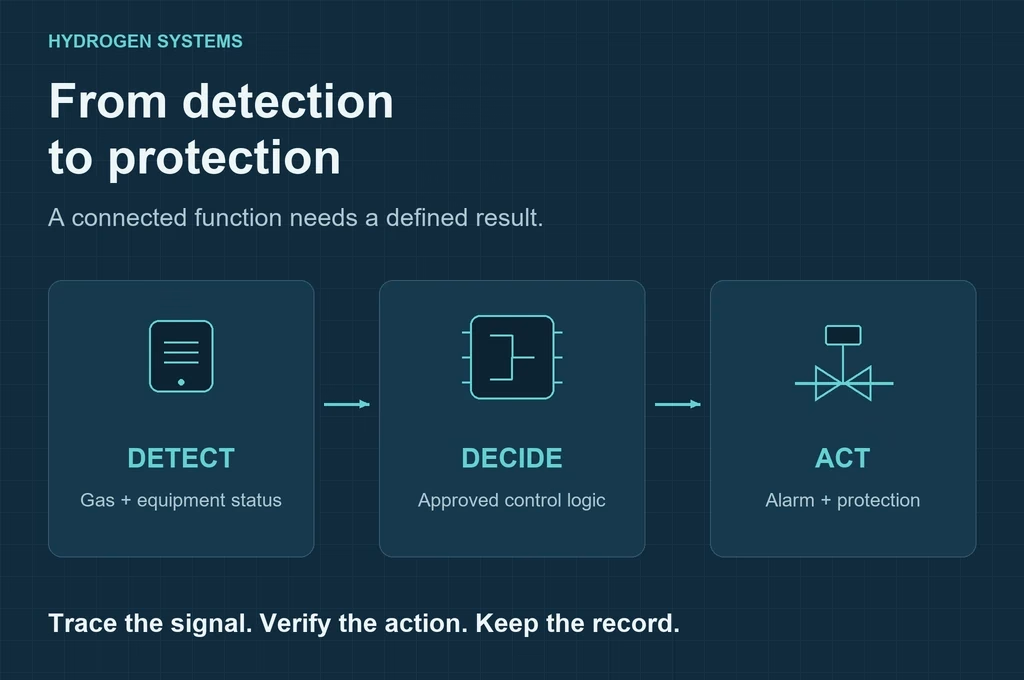

A signal from a hydrogen detector does not mean that the system has completed its protective action. Handing over a system also means explaining what follows that signal: which input calls for which response, and what evidence confirms that the response has actually occurred? If an alarm appears on the screen but the hydrogen supply equipment has not changed state, who assesses the situation and who acts? These questions need answers during design and acceptance, so operators have a procedure to follow when an abnormal condition arises.
This gives procurement and design review a clearer starting point. Before asking how many sensors are needed, establish the scenarios the system must address, then connect the required information, control conditions, and equipment that will act. Sensor performance remains important, but a specification sheet covers only part of the task. Whether system protection is established also depends on the functional relationships between devices and whether those relationships are documented in a form that can be checked.
First, establish what a public example can support
A recent public record from Taiwan offers a way into this work. On June 16, 2026, New Taipei City Fire Department, Ming Chi University of Technology, and industry partners held a hydrogen safety workshop and practical exercise covering hydrogen fuel cell bus systems and emergency response. This was an educational event, not a report of a bus accident. It illustrates the need for different organizations to understand onboard protection; it does not replace performance verification for individual devices.
In its June 18 account of the event, Hyundai Taiwan described design features including hydrogen sensors, normally closed solenoid valves, and thermally activated pressure relief devices (TPRDs). These are the manufacturer's public descriptions. The complete control documentation and independent test results were not available for this article. The discussion below therefore addresses why these functions need to connect with one another, without filling in alarm thresholds, operating times, or control sequences for that vehicle.
The U.S. Department of Energy's hydrogen safety information explains the importance of ventilation and leak detection: hydrogen has a wide flammable concentration range in air and requires little energy to ignite. These properties explain why early information about abnormal conditions matters, but physical properties alone do not determine how an entire system should shut down. Specific protective measures still depend on the intended use, layout, and scenarios that may arise.
Work back from the protective outcome to check each function
Consider a hypothetical project in which the design requires personnel to be notified and the hydrogen supply isolated when a specified leak condition is met. Starting with that intended outcome, work back through the functions: which component performs the isolation, what issues the command, and which inputs establish that the condition has been met? This approach helps reveal missing links. It is an example for discussing functions, not a control scheme that any vehicle or plant can adopt directly.
Within this relationship, inputs, controls, and actions each need a definition. Detectors provide concentration or status information, control equipment makes decisions according to approved logic, and components such as valves act to change the system state. A monitoring screen may display the information without making the protective decision. Documentation should identify the equipment responsible for each function, so uploaded data or an updated display is not taken as evidence that the entire protective path is effective.
Input information must also extend beyond concentration readings. A sensor fault, an unavailable signal, or lost communication may leave the controller without an adequate basis for a decision. These conditions must not be treated as a zero concentration. If an interface provides only simplified status information, the handover needs to explain what each status includes, which abnormal conditions can be recognized, and how the system responds when information is lost. These conditions belong in the design, rather than being left for maintenance staff to interpret by guesswork.
Further along the path, issuing an isolation command and completing isolation are two separate matters to verify. Where a design includes valve position feedback, the documentation can guide checks that the feedback agrees with the equipment state. Without that feedback, it cannot simply be claimed that the controller knows the valve is properly closed. Acceptance evidence must match the functions actually provided, clearly distinguishing the results that can be confirmed from those that still require checks under established procedures.
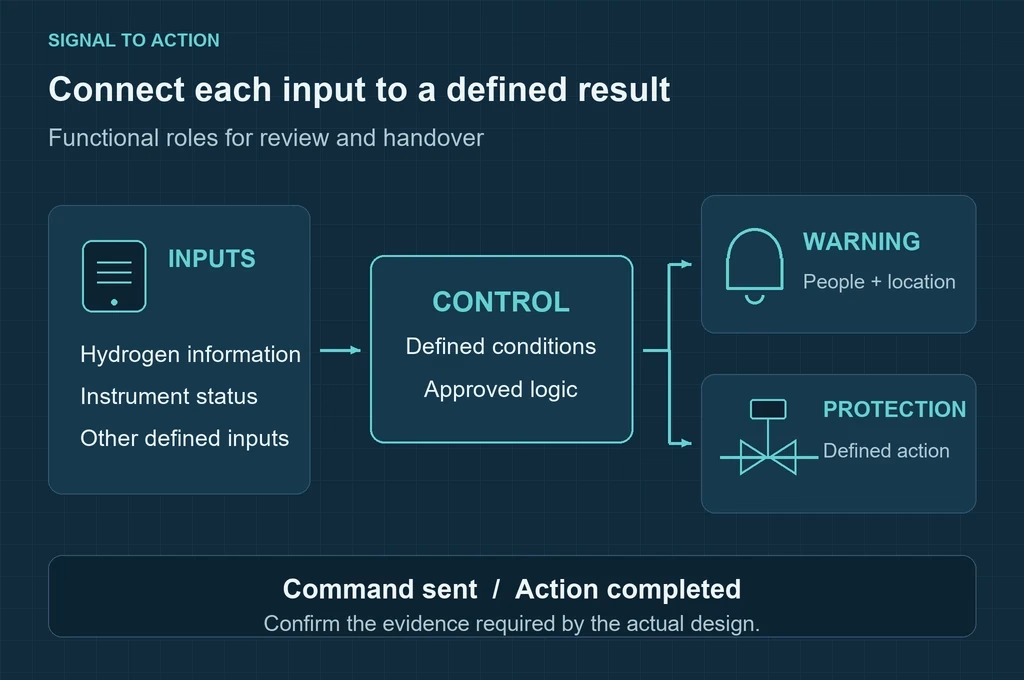
Notifications likewise need identified recipients and follow-up responsibilities. Local warnings, duty station displays, and remote messages may reach different people. An abnormal condition appearing in one place does not mean that every responder has been informed. PNNL's 2020 hydrogen safety planning report includes alarms, operator training, and the assignment of responsibilities. Projects can use this framework to clarify who takes over, rather than verifying only that a message was sent.
The functional relationships are also affected by the physical arrangement. Hydrogen is lighter than air, but its distribution still depends on ventilation, confinement, and equipment geometry. European hydrogen safety engineering guidance includes these conditions in the assessment. Detector locations therefore need a rationale tied to the leak scenarios they address; one universal mounting height cannot cover every space. Changes to covers or airflow also call for a review of the original detection arrangements.
Distinguish protection against leaks from protection under heat exposure
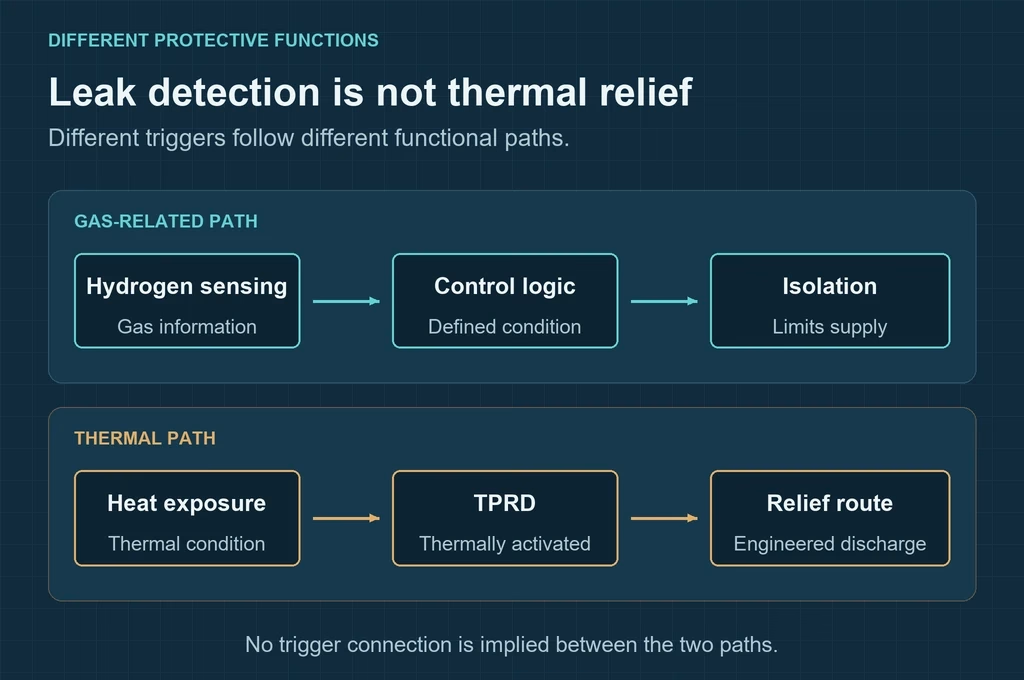
The TPRD found in vehicle documentation belongs on a separate protective path. The public abstract of ISO 19882:2025 covers thermally activated pressure relief devices for compressed hydrogen vehicle fuel containers. These devices address heat exposure, which is different from detecting hydrogen concentration. Drawing a TPRD as a device that opens only after receiving a leak alarm would confuse its trigger condition with its protective purpose.
Hydrogen supply isolation and pressure relief also have different effects. Isolation limits further supply; it does not remove hydrogen already in piping or a space. Heat-triggered relief has its own task in protecting the container. Managing residual gas and coordinating the discharge route with nearby equipment are matters for the overall design. The two paths are shown separately in the illustration to explain their functions, without implying that any actual vehicle uses a particular arrangement.
The need for protection remains when equipment loses power or fails. Turning off all power whenever an abnormal condition occurs may not meet that need, because essential monitoring and ventilation may also require electricity. PNNL includes control faults and safe states in planning. A project needs analysis to determine which equipment stops, which functions remain available, and when restart is permitted. A safe state is a design outcome; it cannot be defined simply as every item of equipment being stopped.
Hand over evidence that remains useful through maintenance
At handover, it should be possible to follow one scenario through its design requirements, equipment assignments, and test results. Approved procedures should verify whether decisions, actions, and indications following an input meet expectations, and establish how fault information and reset conditions are handled. Testing is performed under controlled conditions by personnel with the required competence, not by arbitrarily releasing hydrogen on site to see what happens. Records should enable the next person to distinguish the functions tested and their results from conditions that remain unverified.
That basis needs to continue into maintenance. Replacing a sensor, modifying control software, or adjusting ventilation may change relationships that were previously checked. A repair record saying only "normal operation restored" gives little basis for deciding which tests need to be repeated. Equipment identifiers, configuration versions, details of changes, and relevant verification allow later staff to identify the design on which the current system operates and arrange the tests and inspections that need to be repeated.
For projects in Taiwan, the documentation must also reach clearly identified people, with responsibilities for equipment maintenance, change review, and receiving and addressing abnormal conditions. International technical information can help identify omissions, and vehicle examples can clarify the division of functions. Applicable rules and formal requirements still need to be confirmed against the intended use and manufacturer documentation. Vehicle designs cannot be transferred directly to fixed hydrogen supply systems or industrial sites.
Returning to the handover itself, operators and maintenance staff should be able to explain three things: what information is currently being received, what action the system calls for as a result, and what confirms the outcome. When those answers align with the equipment, versions, and records, the next person has a sound basis for investigating an abnormal condition or a change, following the same functional relationships through the system.
References
- Ming Chi University of Technology: Hydrogen fuel cell bus firefighting, investigation, and hydrogen safety workshop (event: June 16, 2026)
- Hyundai Taiwan: Hydrogen commercial vehicle safety education and protective design (June 18, 2026)
- U.S. Department of Energy: Safe Use of Hydrogen
- PNNL: Safety Planning for Hydrogen and Fuel Cell Projects (2020; equipment integrity and hydrogen safety checklist)
- European Hydrogen Safety Panel: Hydrogen Safety Engineering Guidance (2026; Chapters 2 and 7)
- ISO 19882:2025: Thermally activated pressure relief devices for compressed hydrogen vehicle fuel containers (public abstract)
MTI 巨晶彙審